对存储过程进行加密和解密(SQL 2008/SQL 2012)

开始:
--------------------------------------------------------------------------------------------------------------------------------------------------
在网络上,看到有SQL Server 2000和SQL Server 2005 的存储过程加密和解密的方法,后来分析了其中的代码,发现它们的原理都是一样的。后来自己根据实际的应用环境,编写了两个存储过程,一个加密存储过程(sp_EncryptObject),和一个解密存储过程(sp_EncryptObject),它们可以应用于SQL Server中的储过程,函数,视图,以及触发器
感觉这两个存储过程蛮有意思的,拿来与大家分享;如果你看过类似的,就当作重温一下也好
用于加密的存储过 (sp_EncryptObject
--------------------------------------------------------------------------------------------------------------------------------------------------
存储过程(sp_EncryptObject)加密的方法是在存储过程,函数,视图的“As”位置前加上“with encryption”;如果是触发器,就在“for”位置前加“with encryption”
如果触发器是{ AFTER | INSTEAD OF} 需要修改下面代"For"位置
if objectproperty(object_id(@Object),'ExecIsAfterTrigger')=0 set @Replace='As' ; else set @Replace='For ';
存储过程完成代码
Use master
Go
if object_ID('[sp_EncryptObject]') is not null
    Drop Procedure [sp_EncryptObject]
Go
create procedure sp_EncryptObject
(
    @Object sysname='All'
)
as
/*
    当@Object=All的时候,对所有的函数,存储过程,视图和触发器进行加密
    调用方法
    1. Execute sp_EncryptObject 'All'
    2. Execute sp_EncryptObject 'ObjectName'
*/
begin
    set nocount on

    if @Object <>'All'
    begin
        if not exists(select 1 from sys.objects a where a.object_id=object_id(@Object) And a.type in('P','V','TR','FN','IF','TF'))
        begin
            --SQL Server 2008
            raiserror 50001 N'无效的加密对象!加密对象必须是函数,存储过程,视图或触发器'

            --SQL Server 2012
            --throw 50001, N'无效的加密对象!加密对象必须是函数,存储过程,视图或触发器',1

            return
        end

        if exists(select 1 from sys.sql_modules a where a.object_id=object_id(@Object) and a.definition is null)
        begin
            --SQL Server 2008
            raiserror 50001 N'对象已经加密'

            --SQL Server 2012
            --throw 50001, N'对象已经加密',1
            return
        end
    end

    declare @sql nvarchar(max),@C1 nchar(1),@C2 nchar(1),@type nvarchar(50),@Replace nvarchar(50)
    set @C1=nchar(13)
    set @C2=nchar(10)

    declare cur_Object
        cursor for
            select object_name(a.object_id) As ObjectName,a.definition
                from sys.sql_modules a
                    inner join sys.objects b on b.object_id=a.object_id
                        and b.is_ms_shipped=0
                        and not exists(select 1
                                            from sys.extended_properties x
                                            where x.major_id=b.object_id
                                                and x.minor_id=0
                                                and x.class=1
                                                and x.name='microsoft_database_tools_support'
                                        )
                where b.type in('P','V','TR','FN','IF','TF')
                    and (b.name=@Object or @Object='All')
                    and b.name <>'sp_EncryptObject'
                    and a.definition is not null
                order by Case
                            when b.type ='V' then 1
                            when b.type ='TR' then 2
                            when b.type in('FN','IF','TF') then 3
                            else 4 end,b.create_date,b.object_id

    open cur_Object
    fetch next from cur_Object into @Object,@sql
    while @@fetch_status=0
    begin

        Begin Try

            if objectproperty(object_id(@Object),'ExecIsAfterTrigger')=0 set @Replace='As' ; else set @Replace='For ';

            if (patindex('%'+@C1+@C2+@Replace+@C1+@C2+'%',@sql)>0)
            begin
                set @sql=Replace(@sql,@C1+@C2+@Replace+@C1+@C2,@C1+@C2+'With Encryption'+@C1+@C2+@Replace+@C1+@C2)
            end
            else if(patindex('%'+@C1+@Replace+@C1+'%',@sql)>0)
            begin
                set @sql=Replace(@sql,@C1+@Replace+@C1,@C1+'With Encryption'+@C1+@Replace+@C1)
            end
            else if(patindex('%'+@C2+@Replace+@C2+'%',@sql)>0)
            begin
                set @sql=Replace(@sql,@C2+@Replace+@C2,@C2+'With Encryption'+@C2+@Replace+@C2)
            end
            else if(patindex('%'+@C2+@Replace+@C1+'%',@sql)>0)
            begin
                set @sql=Replace(@sql,@C2+@Replace+@C1,@C1+'With Encryption'+@C2+@Replace+@C1)
            end
            else if(patindex('%'+@C1+@C2+@Replace+'%',@sql)>0)
            begin
                set @sql=Replace(@sql,@C1+@C2+@Replace,@C1+@C2+'With Encryption'+@C1+@C2+@Replace)
            end
            else if(patindex('%'+@C1+@Replace+'%',@sql)>0)
            begin
                set @sql=Replace(@sql,@C1+@Replace,@C1+'With Encryption'+@C1+@Replace)
            end
            else if(patindex('%'+@C2+@Replace+'%',@sql)>0)
            begin
                set @sql=Replace(@sql,@C2+@Replace,@C2+'With Encryption'+@C2+@Replace)
            end

            set @type =
                case
                    when object_id(@Object,'P')>0 then 'Proc'
                    when object_id(@Object,'V')>0 then 'View'
                    when object_id(@Object,'TR')>0  then 'Trigger'
                    when object_id(@Object,'FN')>0 or object_id(@Object,'IF')>0 or object_id(@Object,'TF')>0 then 'Function'
                end
            set @sql=Replace(@sql,'Create '+@type,'Alter '+@type)

            Begin Transaction
            exec(@sql)
            print N'已完成加密对('+@type+')'+@Object
            Commit Transaction

        End Try
        Begin Catch
            Declare @Error nvarchar(2047)
            Set @Error='Object: '+@Object+@C1+@C2+'Error: '+Error_message()

            Rollback Transaction
            print @Error
            print @sql
        End Catch

        fetch next from cur_Object into @Object,@sql

    end

    close cur_Object
    deallocate cur_Object
end

Go
exec sp_ms_marksystemobject 'sp_EncryptObject' --标识为系统对
go
如果SQL Server 2012,请修改下面两个位置的代码。在SQL Server 2012,建议在使用throw来代替raiserror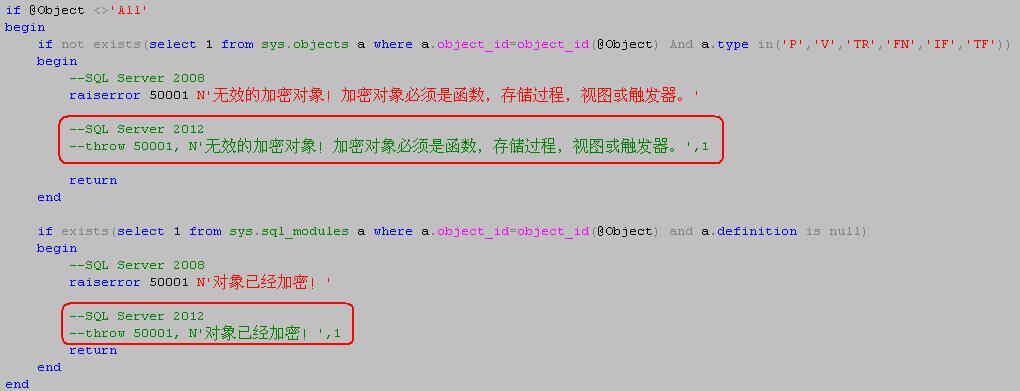
解密方法
--------------------------------------------------------------------------------------------------------------------------------------------------
解密过程,最重要采用异或方法
[字符1]经过函数 fn_x(x)加密变成[加密后字1],如果我们已知[加密后字1],反过来查[字符1],可以这样
[字符1] = [字符2] ^ fn_x([字符2]) ^ [加密后字1]
这里我列举一个简单的例子
--创建加密函数(fn_x
if object_id('fn_x') is not null drop function fn_x
go
create function fn_x
(
    @x nchar(1)
)returns nchar(1)
as
begin
return(nchar((65535-unicode(@x))))
end
go
declare @nchar_1_encrypt nchar(1),@nchar_2 nchar(1)

--对字'A'进行加密,存入变量@nchar_1_encrypt
set @nchar_1_encrypt=dbo.fn_x(N'A')

--參考的字符@nchar_2
set @nchar_2='x'

--算出@nchar_1_encrypt 加密前的字符
select nchar(unicode(@nchar_2)^unicode(dbo.fn_x(@nchar_2))^unicode(@nchar_1_encrypt)) as [@nchar_1]

/*
@nchar_1
--------------------
A
*/
[注] 从SQL Server 2000 SQL Server 2012 采用异或方法都可以解
用于解密的存储过程(sp_DecryptObject):
--------------------------------------------------------------------------------------------------------------------------------------------------
Use master
Go
if object_ID('[sp_DecryptObject]') is not null
Drop Procedure [sp_DecryptObject]
Go
create procedure sp_DecryptObject
(
@Object sysname, --要解密的对象名:函数,存储过程,视图或触发器
@MaxLength int=4000 --评估内容的长
)
as
set nocount on
/* 1. 解密 */
if not exists(select 1 from sys.objects a where a.object_id=object_id(@Object) And a.type in('P','V','TR','FN','IF','TF'))
begin
--SQL Server 2008
raiserror 50001 N'无效的对象!要解密的对象必须是函数,存储过程,视图或触发器'
--SQL Server 2012
--throw 50001, N'无效的对象!要解密的对象必须是函数,存储过程,视图或触发器',1
return
end
if exists(select 1 from sys.sql_modules a where a.object_id=object_id(@Object) and a.definition is not null)
begin
--SQL Server 2008
raiserror 50001 N'对象没有加密'
--SQL Server 2012
--throw 50001, N'无效的对象!要解密的对象必须是函数,存储过程,视图或触发器',1
return
end
declare @sql nvarchar(max) --解密出来的SQL语句
,@imageval nvarchar(max) --加密字符
,@tmpStr nvarchar(max) --临时SQL语句
,@tmpStr_imageval nvarchar(max) --临时SQL语句(加密)
,@type char(2) --对象类型('P','V','TR','FN','IF','TF')
,@objectID int --对象ID
,@i int --While循环使用
,@Oject1 nvarchar(1000)
set @objectID=object_id(@Object)
set @type=(select a.type from sys.objects a where a.object_id=@objectID)
declare @Space4000 nchar(4000)
set @Space4000=replicate('-',4000)
/*
@tmpStr 会构造下面的SQL语句
-------------------------------------------------------------------------------
alter trigger Tr_Name on Table_Name with encryption for update as return /**/
alter proc Proc_Name with encryption as select 1 as col /**/
alter view View_Name with encryption as select 1 as col /**/
alter function Fn_Name() returns int with encryption as begin return(0) end/**/
*/
set @Oject1=quotename(object_schema_name(@objectID))+'.'+quotename(@Object)
set @tmpStr=
case
when @type ='P ' then N'Alter Procedure '+@Oject1+' with encryption as select 1 as column1 '
when @type ='V ' then N'Alter View '+@Oject1+' with encryption as select 1 as column1 '
when @type ='FN' then N'Alter Function '+@Oject1+'() returns int with encryption as begin return(0) end '
when @type ='IF' then N'Alter Function '+@Oject1+'() returns table with encryption as return(Select a.name from sys.types a) '
when @type ='TF' then N'Alter Function '+@Oject1+'() returns @t table(name nvarchar(50)) with encryption as begin return end '
else 'Alter Trigger '+@Oject1+'on '+quotename(object_schema_name(@objectID))+'.'+(select Top(1) quotename(object_name(parent_id)) from sys.triggers a where a.object_id=@objectID)+' with encryption for update as return '
end
set @tmpStr=@tmpStr+'/*'+@Space4000
set @i=0
while @i < (ceiling(@MaxLength*1.0/4000)-1)
begin
set @tmpStr=@tmpStr+ @Space4000
Set @i=@i+1
end
set @tmpStr=@tmpStr+'*/'
------------
set @imageval =(select top(1) a.imageval from sys.sysobjvalues a where a.objid=@objectID and a.valclass=1)
begin tran
exec(@tmpStr)
set @tmpStr_imageval =(select top(1) a.imageval from sys.sysobjvalues a where a.objid=@objectID and a.valclass=1)
rollback tran
-------------
set @tmpStr=stuff(@tmpStr,1,5,'create')
set @sql=''
set @i=1
while @i<= (datalength(@imageval)/2)
begin
set @sql=@sql+isnull(nchar(unicode(substring(@tmpStr,@i,1)) ^ unicode(substring(@tmpStr_imageval,@i,1))^unicode(substring(@imageval,@i,1)) ),'')
Set @i+=1
end
/* 2. 列印 */
declare @patindex int
while @sql>''
begin
set @patindex=patindex('%'+char(13)+char(10)+'%',@sql)
if @patindex >0
begin
print substring(@sql,1,@patindex-1)
set @sql=stuff(@sql,1,@patindex+1,'')
end
else
begin
set @patindex=patindex('%'+char(13)+'%',@sql)
if @patindex >0
begin
print substring(@sql,1,@patindex-1)
set @sql=stuff(@sql,1,@patindex,'')
end
else
begin
set @patindex=patindex('%'+char(10)+'%',@sql)
if @patindex >0
begin
print substring(@sql,1,@patindex-1)
set @sql=stuff(@sql,1,@patindex,'')
end
else
begin
print @sql
set @sql=''
end
end
end
end
Go
exec sp_ms_marksystemobject 'sp_DecryptObject' --标识为系统对
go
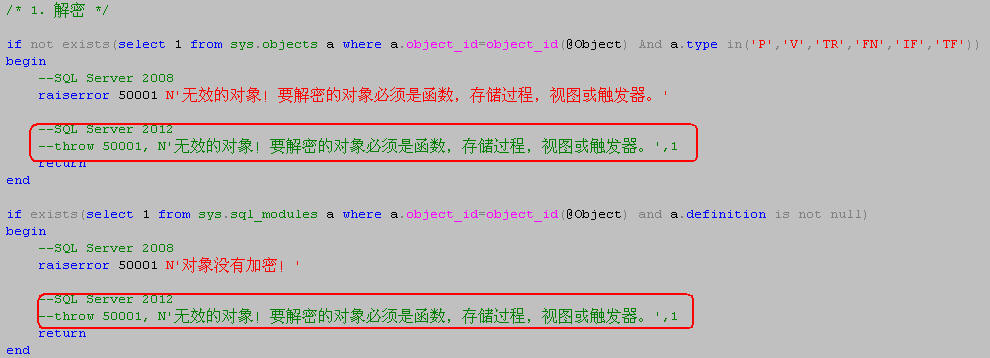
如果SQL Server 2012,请修改下面两个位置的代码。方法类似于前面的加密过程:
搭建测试环境
--------------------------------------------------------------------------------------------------------------------------------------------------
在一个测试环境中(DB: Test),先执行上面的加密存储过程(sp_EncryptObject)和解密存储过程(sp_EncryptObject;再创建两个表:TableA & TableB
use test
go
--创建: TableA & TableB
if object_id('myTableA') is not null drop table myTableA
if object_id('myTableB') is not null drop table myTableB
go
create table myTableA (ID int identity,data nvarchar(50),constraint PK_myTableA primary key(ID))
create table myTableB (ID int ,data nvarchar(50),constraint PK_myTableB primary key(ID))
go
接下来,我们要创6个未加密的对象(对象类型包含 'P','V','TR','FN','IF','TF'):
1.视图(myView):
if object_id('myView') is not null drop view myView
go
create view myView
As
select * from TableA;
go
2.触发器(MyTrigger):
if object_id('MyTrigger') is not null drop Trigger MyTrigger
go
create trigger MyTrigger
on TableA
for update
As
 insert into TableB(ID,data) select a.ID,a.Data From Inserted a
go
3.存储过程(MyProc):
if object_id('MyProc') is not null drop proc MyProc
go
create proc MyProc
(
  @data nvarchar(50)
)
As
insert into TableA(data) values(@data)
go
4.用户定义表值函(TF)(MyFunction_TF):
if object_id('MyFunction_TF') is not null drop function MyFunction_TF
go
create function MyFunction_TF
(
)
returns  @t table
(
    id int,
    data nvarchar(50)
)
As
begin
insert @t(id,data) select id,data from TableA
return
end
go
5.内联表值函(IF) (MyFunction_IF):
if object_id('MyFunction_IF') is not null drop function MyFunction_IF
go
create function MyFunction_IF
(
)
returns table
As
return(select top(3) id, data from TableA order by id desc)
go
6.标量函数(FN)(MyFunction_FN):
if object_id('MyFunction_FN') is not null drop function MyFunction_FN
go
create function MyFunction_FN
(
)
returns nvarchar(50)
As
begin
return(select top(1) data from TableA order by id desc)
end
go
当执行完了上面的1-6步骤的脚本,我们通过查询系统视图sys.sql_modules,可以看到未加密前的定义信息
select b.name as object,b.type,a.definition
    from sys.sql_modules a
        inner join sys.objects b on b.object_id=a.object_id
        where b.create_date>=convert(date,getdate())
        order by b.object_id

加密测试
--------------------------------------------------------------------------------------------------------------------------------------------------
下面我就通过调用加密存储过程(sp_EncryptObject),一次性对它们进行加密
use test
go
exec sp_EncryptObject 'all'
go
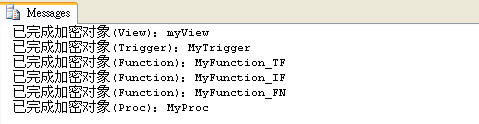
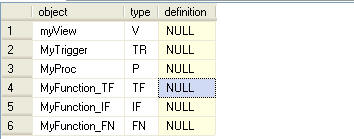
当我们再查回系统视图sys.sql_modules,会发现definition列返回的是null值,说明定义内容已经给加密:
解密测试
--------------------------------------------------------------------------------------------------------------------------------------------------
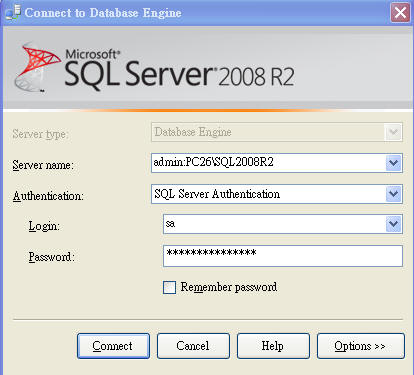
解密过程,必须在DAC连接SQL Server,我们这里例子是 SSMS(SQL Server Management Studio) 查询编辑器启 DAC,如图:
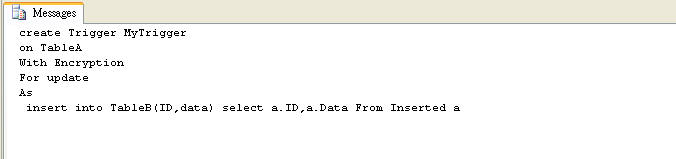
解密存储过程(sp_DecryptObject),只能一次对一个存储过程、函数、视图或触发器,进行解密
use test
go
exec sp_DecryptObject MyTrigger
go
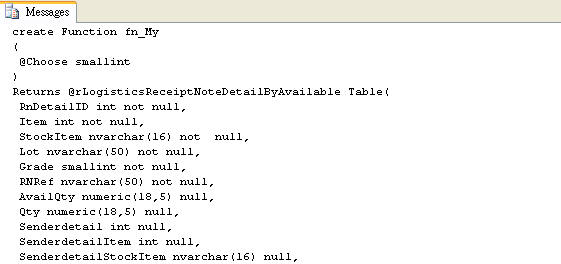
当定义内容长度超4000,我们可以指定@MaxLength的值,如:
exec sp_DecryptObject fn_My,20000
go
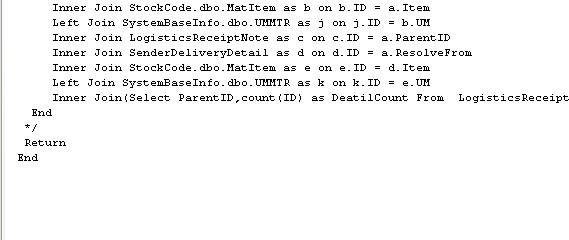
这里(fn_My)是一个函数,定义内容超过8000
.........
小结
--------------------------------------------------------------------------------------------------------------------------------------------------
虽然,上面的脚本,我已经在SQL Server 2008 R2 和SQL Server 2012测试过,但无法避免一些未知错 。如果你自己在测试上面的脚本,请不要在生产环境上。如果你在应用过程,碰到有什么问题或有什么意见和建议可以发email联系我或跟帖,在此非常感谢!
![[分享]工单按工作中心工单状态月份合计工单数](/content/uploadfile/201609/29751475135708.png)
发表评论